
For travelers from North America or Europe, walking into a restaurant in South Korea can feel like a dream come true for one specific reason: There is absolutely no tipping culture.
Understanding basic Korean restaurant etiquette is incredibly easy. The price you see on the menu is exactly what you pay. No 20% math, no hidden service fees, and no social pressure.
However, while the payment is simple, the “system” inside the restaurant might surprise you. From hidden drawers to scissors on the table, here is everything you need to know about Korean restaurant etiquette to dine like a local.
1. Keep Your Change: Why You Should Never Tip
In South Korea, tipping is not expected and can sometimes even be confusing for the staff. Service is considered a part of the hospitality already included in the price.
If you try to leave money on the table, a waiter might actually chase you down the street thinking you forgot your change!
2. Where Are the Spoons? (The Secret Drawer)
You sit down, your food arrives, but the table is empty of utensils. Don’t panic and don’t wait for the waiter to bring them.
- The Pro Tip: Look at the side of your table. Most Korean restaurants have a sliding drawer tucked under the tabletop. Inside, you will find neatly organized spoons, chopsticks, and napkins. It is a brilliant space-saving hack!
3. The Magic “Call Button”
In many Western cultures, waving or shouting at a waiter is considered rude. In Korea, trying to make eye contact with a busy server might take forever.
- The Solution: Look for a small round button on your table. Give it a press, and you will hear a “Ding-dong!” sound. This notifies the staff that you need assistance. It is the most efficient way to order more drinks or ask for the bill.
4. The Glory of “Banchan” (Free Side Dishes)
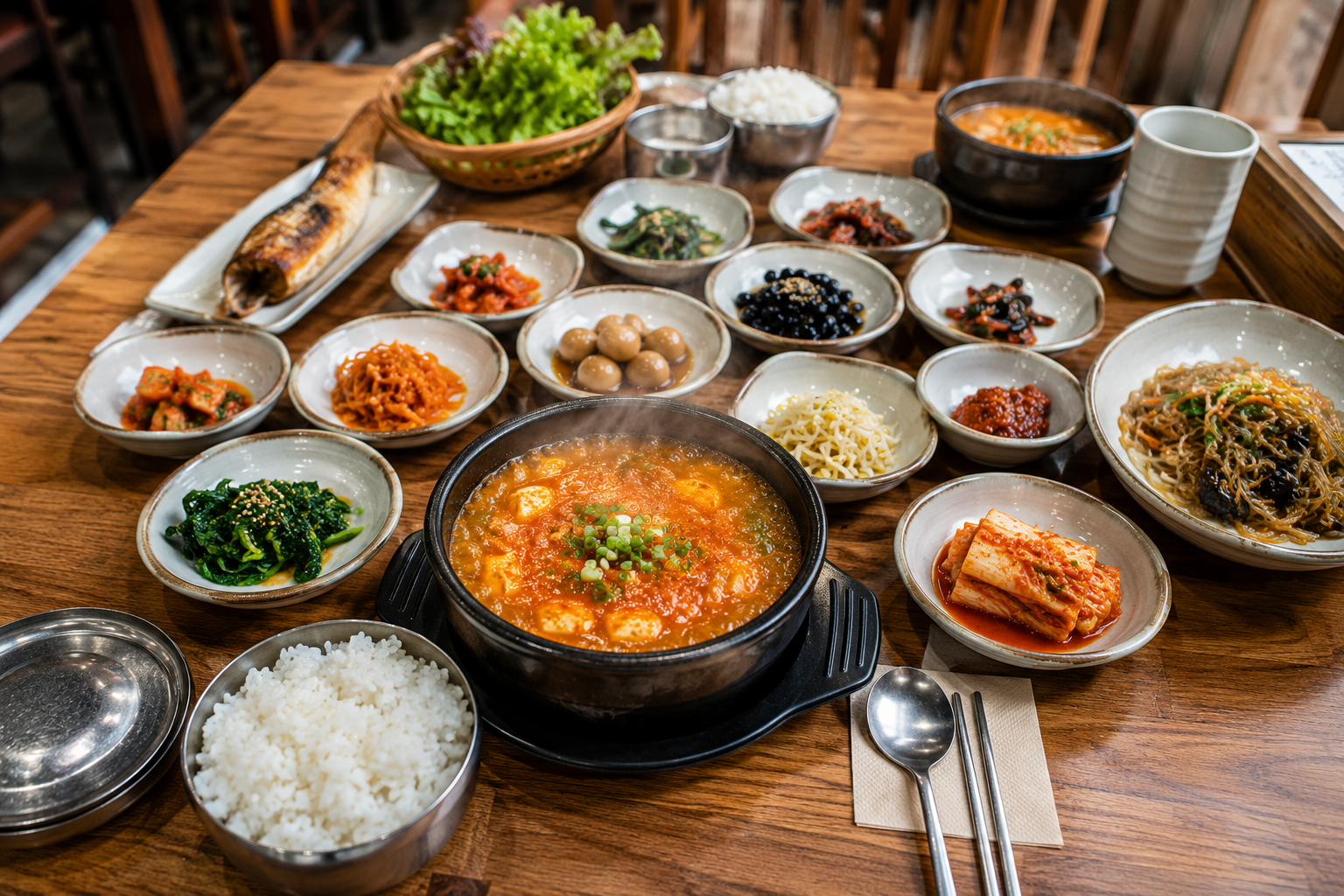
One of the best parts of Korean dining is Banchan. Before your main dish arrives, the table will be filled with various small plates like Kimchi, bean sprouts, and pickled radish.
- The Best Part: These side dishes are completely free and unlimited. If you finish a dish you really like, just say “I-geo deo ju-se-yo” (More of this, please) or look for a “Self-Service” bar to refill them yourself.
5. Why Is There a Pair of Scissors on My Table?
If you order BBQ or cold noodles (Naengmyeon), the server will likely hand you a large pair of kitchen scissors.
In Korea, scissors are a standard culinary tool. They are used to cut long noodles or thick pieces of meat right at your table into bite-sized chunks. It is much more efficient than using a knife!
6. How to Pay: The Counter is King
In most casual and mid-range restaurants, you don’t wait for the bill at your table.
- The Process: Look for a small clipboard or slip of paper that the waiter left on your table when the food arrived. Take that paper to the front counter near the exit to pay your bill before leaving.
A Local’s Insight for Business Travelers If you are visiting industrial areas like Hwaseong or other parts of Gyeonggi-do for a business meeting or factory tour, you might visit “Baekban” (fixed menu) restaurants near the plants. These places are incredibly fast and efficient. Just sit down, and within 5 minutes, a full healthy meal will appear. It is the perfect example of Korea’s Pali-Pali (hurry-hurry) culture at its finest.