
For decades, the manufacturing industry has relied heavily on human inspectors to ensure product quality. However, as production speeds increase and product geometries become more complex, the limitations of the human eye are becoming apparent.
Welcome to the era of the Smart Factory. The transition from manual inspection to AI machine vision in manufacturing is no longer just a trend; it is an absolute necessity for survival. Here is how Automated Optical Inspection (AOI) powered by Artificial Intelligence is revolutionizing quality control.
1. The Hidden Costs of Manual Inspection
Even the most highly trained quality inspectors suffer from fatigue. Studies show that human inspection accuracy drops significantly after just a few hours of continuous work.
- The Consistency Problem: Manual inspection is subjective. A microscopic scratch might be passed by a day-shift operator but rejected by a night-shift operator. This inconsistency leads to both high false-reject rates (wasting good products) and defect leakages (harming brand reputation).
2. Moving Beyond Traditional AOI
Traditional Automated Optical Inspection (AOI) systems have been used for years, but they are typically “rule-based.” You have to program exact parameters, such as specific dimensions or colors. If a defect looks slightly different than the programmed rule, the traditional machine misses it.
- The AI Advantage: Modern AI machine vision in manufacturing utilizes deep learning algorithms. Instead of programming strict rules, you feed the AI thousands of images of both “good” and “defective” products. The neural network learns to identify anomalies—like irregular surface scratches or subtle misalignments—just like a human brain, but with absolute mathematically driven consistency.
3. Data-Driven Predictive Quality
An AI vision system does not just separate the good parts from the bad; it acts as a massive data-generation engine.
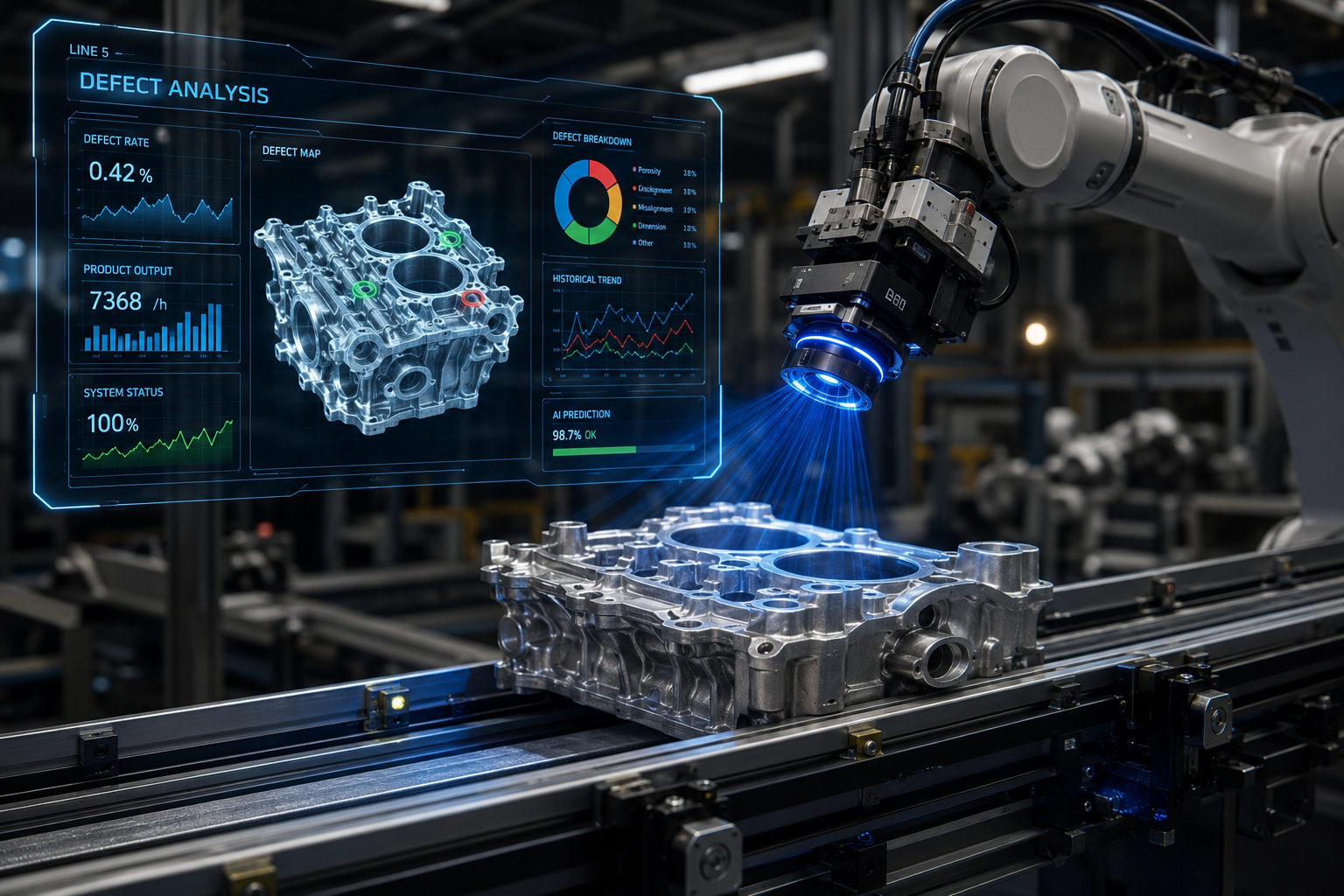
- Connecting to the MES: When integrated with a Manufacturing Execution System (MES), the AI camera records the exact coordinates and types of defects in real-time. If the system detects a sudden spike in a specific defect mode, it can automatically alert the engineering team or even pause the machine before a massive scrap event occurs.
4. Overcoming Implementation Challenges
Transitioning to an AI-driven quality system is a major project that requires careful change management. The biggest hurdle is not the technology itself, but the organizational mindset.
- A Phased Rollout: Do not try to automate every inspection point at once. Start with a hybrid approach. Let the AI flag potential defects, and have a senior human inspector make the final decision. This “human-in-the-loop” phase allows the AI model to learn from human corrections, steadily increasing its accuracy until it is ready for full autonomy.
5. The Evolving Role of the Quality Engineer
There is a common fear that AI will replace quality jobs. In reality, it simply elevates them.
- From Inspectors to Data Analysts: As cameras take over the tedious visual sorting, quality engineers will transition into higher-value roles. They will focus on training the AI models, analyzing defect trends, and optimizing the upstream manufacturing processes.
By embracing AI and machine vision, manufacturers can achieve near-zero defect rates, turning their quality control department from a cost center into a significant competitive advantage.