
If you are planning a trip to South Korea, figuring out how to handle your money is one of the most important steps. Is Korea completely cashless? Do you need to carry millions of Won in your wallet? And what about Apple Pay?
South Korea has one of the most advanced digital payment infrastructures in the world. However, as a tourist, relying on just one payment method can lead to unexpected problems. To help you save on foreign transaction fees and travel seamlessly, here is the complete 2026 guide on how to pay in South Korea.
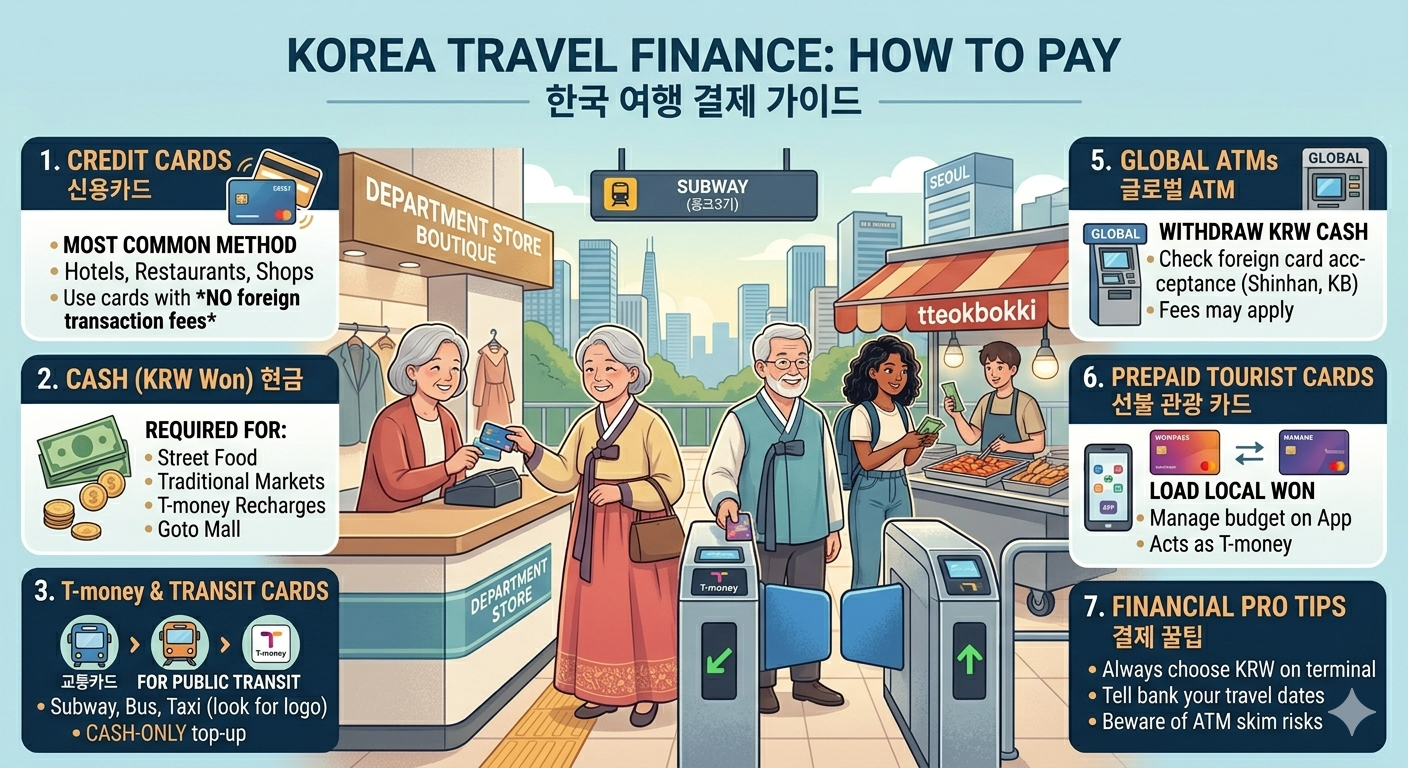
1. Credit Cards (Your Primary Payment Method)
South Korea is heavily a cashless society. You can use international credit and debit cards (Visa, Mastercard, and American Express) at roughly 95% of establishments, from high-end hotels and department stores to tiny corner cafes and convenience stores.
- The Best Strategy: Bring a credit card with no foreign transaction fees to avoid the extra 2-3% charge on every purchase.
- Apple Pay & Google Pay: While domestic mobile payments (Samsung Pay) rule Korea, Apple Pay is now accepted at major convenience stores, department stores (Hyundai), and many franchise cafes. However, physical cards are still highly recommended as many local mom-and-pop restaurants do not have NFC terminals.
- Important Rule: When a card terminal asks if you want to pay in your home currency or KRW (Korean Won), always choose KRW. This avoids Dynamic Currency Conversion (DCC) and gets you a much better exchange rate.
2. When Do You Actually Need Cash?
Even though cards are accepted almost everywhere, you cannot survive in Korea with zero cash. You must carry around 50,000 to 100,000 KRW (approx. $40–$80) in physical cash for the following situations:
- T-money Card Top-ups: The essential public transit card can only be recharged with physical cash at subway machines or convenience stores.
- Street Food & Traditional Markets: If you want to eat at Gwangjang Market or buy Myeongdong street food, cash is king.
- Small Underground Shopping Malls: Places like the Goto Mall (Express Bus Terminal) often offer significant discounts if you pay in cash instead of a credit card.
3. Currency Exchange vs. Global ATMs
Where should you get your Korean Won?
- Avoid the Airport: The currency exchange counters at Incheon Airport have the worst exchange rates. Only exchange a small amount (like $50) for your immediate transport and T-money needs.
- Myeongdong Exchange Offices: If you brought physical USD, EUR, or JPY, the private exchange booths located in the alleys of Myeongdong offer the absolute best rates in the country.
- Global ATMs: A more convenient option is withdrawing cash from a Global ATM (found in convenience stores or major banks like Shinhan or KB). If your bank offers a travel debit card that reimburses international ATM fees (like Charles Schwab), this is your best option.
4. Tourist Prepaid Cards (WOWPASS & Namane)
If you want to avoid carrying loose change and track your budget on an app, consider getting a tourist-exclusive prepaid card:
- WOWPASS: You can insert your foreign currency (USD, EUR, etc.) directly into a WOWPASS machine (found in subways and hotels), and it will issue a physical card loaded with Korean Won. It also acts as a T-money transit card!
- Namane Card: Similar to WOWPASS, but you can print your own photo (or your favorite K-pop idol’s face) on the card, making it a great personalized souvenir.
Final Thoughts To travel South Korea like a pro, the best financial strategy is a hybrid approach. Bring a solid travel credit card without international fees for your daily dining and shopping, withdraw a small amount of KRW cash from an ATM for street food and transit, and enjoy a hassle-free trip!