When most people think of visiting South Korea, they picture the neon lights of Seoul or the beaches of Busan. However, if you are traveling to Korea for business, supply chain management, or manufacturing audits, your destination is likely outside the capital.
Cities like Hwaseong, Suwon, and Pyeongtaek in Gyeonggi-do are the beating heart of Korea’s industrial and tech economy. Home to massive semiconductor plants, automotive parts suppliers, and electronic component manufacturers, these cities operate on a completely different rhythm than Seoul. Here is everything a foreign business traveler or expat needs to know to survive and thrive in Korea’s manufacturing hubs.
1. Transportation: How to Navigate the “Factory Zones”
While Seoul has a subway station on every corner, industrial hubs are heavily spread out. Many major factories and supplier plants are located in remote industrial complexes (called Sandan).
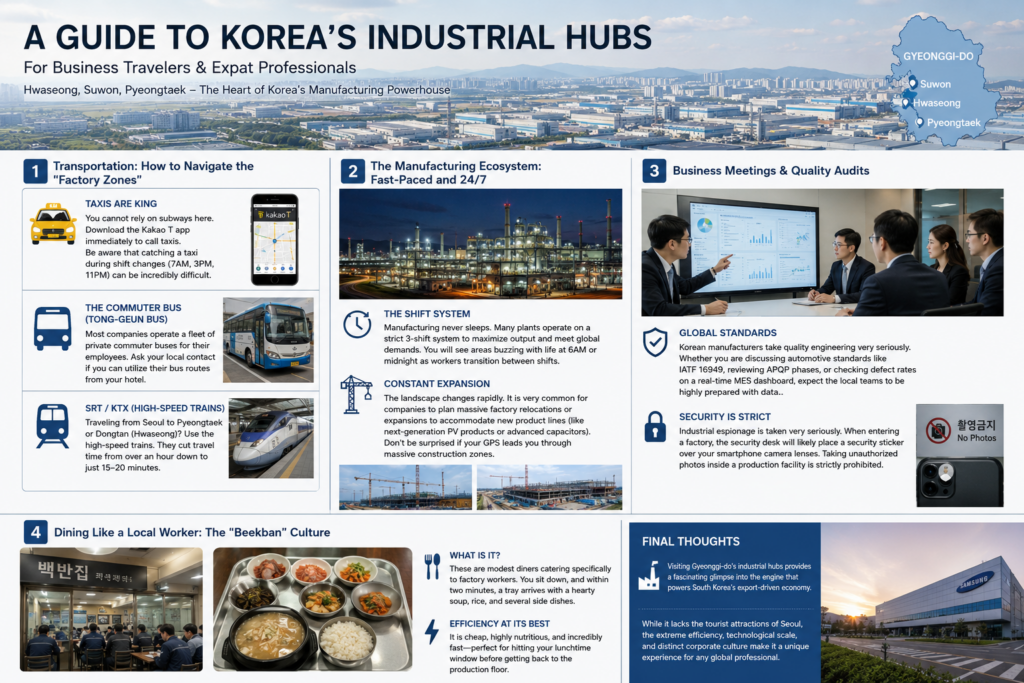
- Taxis are King: You cannot rely on subways here. Download the Kakao T app immediately to call taxis. Be aware that catching a taxi during shift changes (usually around 7:00 AM, 3:00 PM, or 11:00 PM) can be incredibly difficult.
- The Commuter Bus (Tong-geun Bus): Most mid-to-large sized companies operate a fleet of private commuter buses for their employees. If you are visiting a partner company for several days, ask your local contact if you can utilize their bus routes from your hotel.
- SRT / KTX (High-Speed Trains): If you are traveling from Seoul down to Pyeongtaek or Dongtan (Hwaseong), use the high-speed trains. They cut the travel time from over an hour down to just 15-20 minutes.
2. The Manufacturing Ecosystem: Fast-Paced and 24/7
The work culture in Gyeonggi-do is highly driven by production schedules.
- The Shift System: Manufacturing never sleeps. Many plants operate on a strict 3-shift system to maximize output and meet global demands. You will see areas buzzing with life at 6:00 AM or midnight as workers transition between shifts.
- Constant Expansion: The landscape changes rapidly. It is very common for companies to plan massive factory relocations or expansions to accommodate new product lines (like next-generation PV products or advanced capacitors). Do not be surprised if your GPS leads you through massive construction zones.
3. Business Meetings & Quality Audits
If you are visiting to conduct a supplier audit or a quality management review, be prepared for intense, highly structured professionalism.
- Global Standards: Korean manufacturers take quality engineering very seriously. Whether you are discussing automotive standards like IATF 16949, reviewing APQP phases, or checking defect rates on a real-time MES (Manufacturing Execution System) dashboard, expect the local teams to be highly prepared with data.
- Security is Strict: Industrial espionage is taken very seriously. When entering a factory, the security desk will likely place a security sticker over your smartphone camera lenses. Taking unauthorized photos inside a production facility is strictly prohibited.
4. Dining Like a Local Worker: The “Baekban” Culture
You won’t find many fancy Michelin-starred restaurants near the industrial parks. Instead, you will experience the ultimate Korean fast food: The Baekban (fixed menu) restaurant.
- What is it? These are modest diners catering specifically to factory workers. You sit down, and within two minutes, a tray arrives with a hearty soup, rice, and several side dishes.
- Efficiency at its Best: It is cheap, highly nutritious, and incredibly fast—perfect for hitting your lunchtime window before getting back to the production floor.
Final Thoughts Visiting Gyeonggi-do’s industrial hubs provides a fascinating glimpse into the engine that powers South Korea’s export-driven economy. While it lacks the tourist attractions of Seoul, the extreme efficiency, technological scale, and distinct corporate culture make it a unique experience for any global professional.