If you are planning a trip to South Korea, one of the most important things to consider is your budget. Can you visit Seoul on a backpacker’s budget, or is it as expensive as Tokyo or New York?
The good news is that Korea can be incredibly affordable or luxuriously expensive, depending entirely on your travel style. Understanding typical costs for 2026 will help you plan your trip efficiently and avoid unexpected expenses. Here is your comprehensive guide to travel costs in South Korea (Prices are estimated in USD for easy planning).
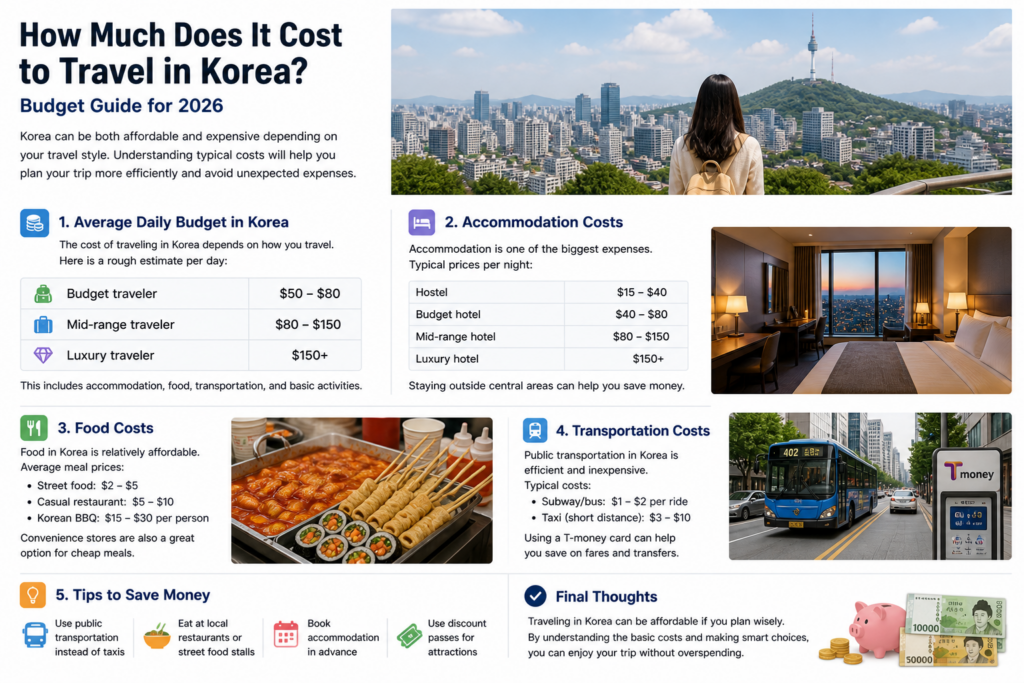
Average Daily Budget in Korea
The cost of traveling in Korea fluctuates based on where you sleep and what you eat. Here is a realistic daily estimate per person (excluding your flights):
Luxury Traveler ($150+/day): Staying in 4 or 5-star hotels (like in Gangnam or Haeundae), dining at fine restaurants or trendy cafes, and booking private tours.
Budget Traveler ($50–$80/day): Staying in hostel dorms, eating street food or at local diner chains (like Kimbap Cheongguk), and using public transit heavily.
Mid-Range Traveler ($80–$150/day): Sleeping in 3-star private hotel rooms, dining at nice BBQ restaurants, visiting paid attractions, and occasionally taking taxis.
1. Accommodation Costs
Accommodation will be your biggest expense. Fortunately, Korea has options for every price range. Staying slightly outside hyper-touristy areas (like moving from Myeongdong to Mapo-gu) can help you save money.
- Hostel/Guesthouse ($15–$40/night): Perfect for solo travelers. Areas like Hongdae and Itaewon are packed with clean, affordable hostels.
- Budget Hotel or Airbnb ($40–$80/night): Great for couples looking for private rooms without breaking the bank.
- Mid-Range Hotel ($80–$150/night): Comfortable 3 to 4-star hotels with great amenities, highly concentrated in Myeongdong and Jongno.
- Luxury Hotel ($150–$300+/night): Premium global brands and high-end local hotels, mostly located in Gangnam, Yeouido, or beachfronts in Busan.
2. Food and Dining Costs
Food in Korea is both delicious and relatively affordable. You don’t need to spend a lot to eat very well.
- Street Food & Convenience Stores ($2–$5): Tteokbokki (spicy rice cakes), Odeng (fish cakes), or a quick Triangle Gimbap from a CU or GS25 convenience store.
- Casual Local Restaurants ($5–$10): A hearty bowl of Bibimbap, Pork Cutlet (Tonkatsu), or Kimchi Stew usually costs around 8,000 to 12,000 KRW.
- Korean BBQ ($15–$30 per person): A proper Samgyeopsal (pork belly) or Hanwoo (Korean beef) dinner with drinks.
- Cafe Culture ($4–$7): Koreans love coffee. An iced Americano at an aesthetic cafe will set you back about $4 to $6.
3. Transportation Costs (2026 Updates)
Public transportation in Korea is world-class, spotless, and inexpensive.
- Subway & Bus: The base fare for the Seoul subway recently increased to 1,550 KRW (approx. $1.15) per ride.
- Taxis: Taxis are cheaper than in most Western countries. A short 10-minute ride usually costs between $4 and $7. Use the Kakao T app to avoid overcharging.
- Intercity Travel: The KTX (bullet train) from Seoul to Busan takes about 2.5 hours and costs around $45 (59,800 KRW). Express buses are slower but cost half the price.
4. Top Tips to Save Money in 2026
If you want to stretch your budget further, keep these smart tips in mind:
- Get a Climate Card (Tourist Pass): If you are staying in Seoul, skip the regular T-money card and buy the new “Climate Card” short-term pass at subway stations. It gives you unlimited subway and bus rides in Seoul (1-day for 5,000 KRW, 3-day for 10,000 KRW, or 7-day for 20,000 KRW).
- Buy the Discover Seoul Pass: If you plan to visit multiple paid attractions (like N Seoul Tower, Lotte World, and Hanbok rentals), this pass offers massive bundled discounts.
- Eat at Traditional Markets: Places like Gwangjang Market in Seoul offer massive portions of authentic food for a fraction of the price of restaurant meals.
Final Thoughts Traveling in Korea doesn’t have to empty your wallet. By understanding the basic costs, utilizing unlimited transit passes like the Climate Card, and mixing street food with restaurant meals, you can enjoy a rich and memorable trip comfortably within your budget.